By now most of you would have heard at least once why writing by hand is so important.
There are the studies, the quote snippets and blog posts, even the online trends glorifying the return to the traditional in resistance to the relentless digitisation of the world. Whether it’s purely for the aesthetic or also for the benefits, it hardly matters as much as what we personally choose to do with it.
For me writing by hand has always been a no-brainer. I never even thought of it as something “special” to be brought up and advocated, but I suppose my inner way of living has always been more Old World charm than wireless gadgets. I was, of course, aware of how the art has been fading – alarmingly so – but it was the advent of AI that really threw this aspect of human creativity on the front page of my writer’s consciousness.
No, this post is not about AI, but it does strongly concern reclaiming our full human power and literary skill, AI or not. I am by no means against typing up stories, either: I work with both, like a literary centaur with hooves in the past and hands in the future. I don’t believe in drawing up unnecessary battle lines where they don’t need to exist.
What I do believe in are the innumerable benefits we as writers and authors specifically stand to gain from writing by hand. A paper synthesizing the findings from multiple neuroimaging studies, published in Life*, delved into the myriad differences between writing by hand versus typing on a keyboard and its effect on the brain. The main verdict is how handwriting activates a broader network of brain regions involved in motor, sensory, and cognitive processing, whilst typing engages fewer neural circuits and results in more passive engagement.
The paper stresses that handwriting is an acquired skill, gained through conscious learning and experience. It’s easy to forget as phone-tapping adults how long it took to learn it as kids, or how many rows of a’s and v’s we had to write on the lines in a school book.
So why would we let a skill that we earned with such difficulty degrade away?
Benefits of Writing By Hand
⪢ It strengthens memory and learning through the “encoding effect”: the effort of forming letters improves retention and comprehension. We’ll remember our own ideas and plot points better, and hold the threads of our storylines at easier recall.
⪢ It activates a larger visuomotor network compared with typing, drawing in multiple senses that strengthen the memory. Also very useful for storytellers who need to integrate all the senses into the experience of the story and convey that to the reader in a believable way.
⪢ Handwriting engages multiple brain regions at the same time, structuring knowledge into interconnected networks. We want brains that are able to handle the complexity of our sprawling fantasy worlds, right? Even a single standalone book can be a complex project, whose multiple aspects can easily slip from our control if we don’t pay attention.
⪢ Positive mood during learning is higher during handwriting than typing.
None of that “tortured artist” vibe here – let loose and have fun.
⪢ Slower pace fosters deeper thought and creativity, better reflective processing
Less rushed scenes, more thoughtful interactions and themes, improved story dynamics.
⪢ Handwriting may offer long-term benefits on brain function preservation
You can continue writing at 95 🙂
As a side note: the study finds that due to its fluidity, cursive actually involves greater activation of the motor cortex and cerebellum. I bet reading it also makes you better at cryptography.
So how do we play this?
In the era of *productivity* above all, the counter-movement has called for intentional slowing down, the claiming of a more present and unhurried pace. This goes for writing as well. Whilst there’s a real world of deadlines out there, answer me this:
Have you ever felt your prose degenerating in front of your eyes the more you try to rush it?
Your sentences slurring into slop the more you set quotas and formats and productivise it into a measurable performance?
Have you ran inchoate prompts through an LLM just to end up with a paragraph that has a rice cake for a soul instead of a Sachertorte?
Yeah, thought so. If not, you’ve unlocked some next level and good for you, but for most writers the creative craft isn’t something to be whipped about a corral. It needs to be respected and gently coaxed, treated like an oft-capricious wild horse that’s willing to carry you if you treat it well. This is where the thoughtful approach of writing by hand comes in.
Writing by hand is not merely about making some vague anti-digital statement in your aesthetic cottagecore journalling montage, but about improving yourself as a writer. In addition to the aforementioned, the most simple and applicable benefit I’ve gained from it as a writer of fiction (or non-fiction) can be broken down into the following parts.
I. Writing by hand as the First Pass.
This is the bricks, the pure clay thrown at the mould, the most basic bones and the rough sketch. This writing pass doesn’t concern itself with pretty prose and perfect characterisations, but mixes up the basic dough for a cake that you’ll later bake and decorate.
⨳ Bare elements only = Keeping it stress free.
The stress brought on by the reach for perfection can be almost entirely snuffed out at this stage, because a house in construction is always unsightly. It’s just batter; it doesn’t need to be pretty yet. And that’s the magic: if your goal is to write a page a day in your manuscript notebook, you simply do that. You write a page.
And you don’t give a damn how bad it is.
I have written pages where I’m making notes about the cringe as I go, or scrawling quick symbols for editing about fluffing up some passage. I know I’ll fix it in post-production until it shines like a zirconium, so I hold on to zero shame as I write a sentence as beautiful as little Timmy’s in his third-grade essay about dinosaurs. And if you happen to get lucky with a wild flow where Nobel-worthy sentences splash onto the page straight away, that’s a wondrous side effect.
II. Typing it up as the Second Pass.
Simply writing it out on your computer already doubles up as your first round of editing. *chef’s kiss.*
It’s a sly, baked-in way of getting in some polish without distracting from the creative flow too much, since many folks find that their creativity crumples up when the editor brain goes online. All at once, you’re not only continuing and filling out the text you wrote out by hand, but you’re also instantly noticing its deficiencies. Since your brain has already had some distance from the first pass, the repetitions, flat descriptions and grammar mistakes jump at you with greater eagerness.
Now you can simply fix them as you write, and the river runs on.
Final Thoughts
Even with all the goodies that come with it, writing by hand might still seem too time-consuming and onerous. Yet, paradoxically, the things we shun most for their inefficiency are usually the same ones that save us.
The slow mornings; leisurely walks in the mist; writing a page of frolicking gibberish in a pretty notebook. The process of writing great prose was never meant to be a bullet train that zaps past the views in the window, but a locomotive that takes us on a journey where we learn about the world around us, immerse ourselves in the craft and reconnect with the deeper currents between the surface.
That doesn’t mean the pace of the prose or the writing itself has to be slow, but it has to be present. The best of the fast-paced, gripping thrillers I’ve read had a je ne sais quoi that set them apart from the garden variety action flick. They were grounded in their world, unhurried in the unfolding, and yet not a bit too slow. This kind of writing is not detached from itself or the true depth of the author’s soul, which is exactly what too much of modern literature unfortunately sounds like.
I have no idea whether some of these authors write by hand or not, and that in itself doesn’t confer some magical power. But it does slow us down enough to really think about what we’re doing, and provides that automatic second review. It’s an act of rebellion against the haste and marketing numbers, a practise that sets a boundary between us and the demands of an ultimately fake world.
We might have to play on that board to find success, but nobody said we have to play as pawns.
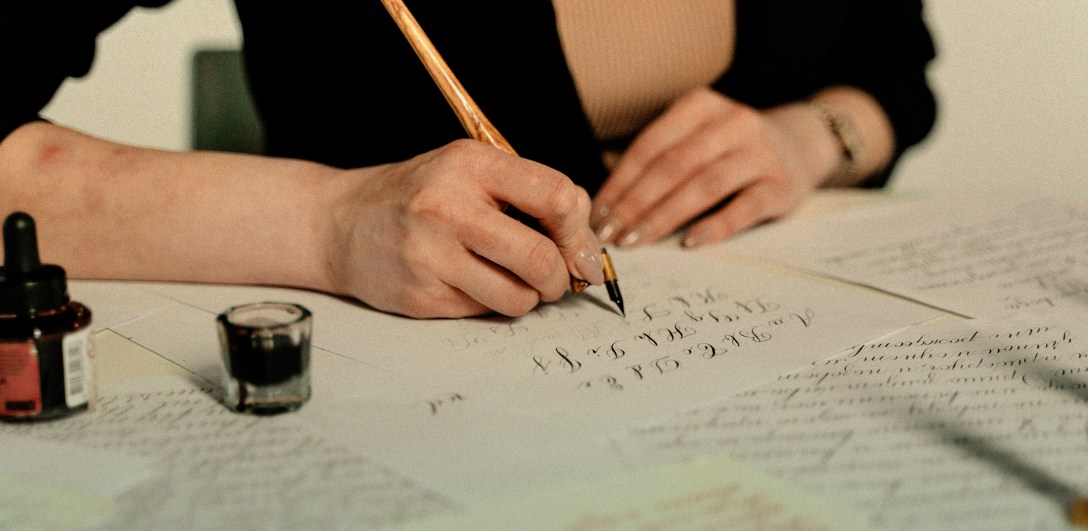
So go ahead, write a few lines by hand today. Enjoy the glide of the pen on paper, and see what the shapes tell you about yourself.
Hopeful handwriting,
x The Foxglove Scribe
Source:
*Life (Basel). The Neuroscience Behind Writing: Handwriting vs. Typing –
Who Wins the Battle? 2025 Feb 22;15(3):345. doi: 10.3390/life15030345
Header image by: MART PRODUCTION, Pexels. Edited.
Cursive image by rawpixel.com

 The Foxglove Scribe