
“My writing is stale.”
“I wish I could write more cleverly.”
“Why can’t my sentences sound poetic??”
“Pretty words are so hard.”
“There’s no flow to my prose.”
Any of these sound familiar?
Not everyone has a naturally poetic or lyrical style, but maybe you’d like a bit more flourish and natural colour to your prose: a streak of deep oxblood, a dash of gold, a dusting of jade. Perhaps your golden prize as a writer is achieving a style that would make angels cry, and in that case: do read on.
Read on even if you simply want to give your prose a little mauve tint, without going full-on purple. (That’s not recommended to anyone, by the way.)
These ideas are simple, low-key and might surprise you with the results. When I feel like my prose is beginning to tread the wheel of crutchy sentences and boring words, I break out one of these and go ham.
I. Stream of Consciousness
Exactly what it sounds like. You put on a timer for however long you want (could be anything from three minutes to thirteen) and you write whatever comes to your mind without stopping to think about it at all. That’s the key: no breaks, no conscious thoughts or judgements. When I first tried this many years ago, I was shocked at how effective it was.
🔸Write your text as full-on paragraphs or as lines of poetry, or something in-between, as long as you don’t pay attention to the words that flow out of you. It might be pure drivel at first, but sometimes the only way we can unlock the hidden music of words inside us is not to block it with conscious thought. We’re trying to bypass the higher-order, executive functions of the frontal lobe entirely, and sneak through the window to the corner of the brain where poets hang out.
The result may or may not be usable in itself, but boy, have I produced a ton of great raw material for my writing this way. As an extra effect: do it for enough pages and you’ll probably get a therapy session out of it, too. When the subconscious starts speaking, it usually has a lot to say.
2. New Combinations
A huge part of the beauty and power of gorgeous writing comes from the unexpected, clever and fresh ways in which words are used. One way to make yourself think about words out of the eternal box is by using lists of words as raw material in new combinations.
🔸A few ideas to come by these:
I. Set a timer for 2-3 minutes and write down as many adjectives as you can.
II. In a separate column, do the same with nouns or some other type of word.
III. You can also use the time to write down ANY words you can think of that are a colour, start with a specific letter, describe a place, etc. Up to you. (This is a great vocabulary exercise just on its own, fyi)
IV. Find a ready-made list online, maybe “the 80 most beautiful words in English”.
Pro: this is also a great way to learn new vocabulary.
🔸 Now – Mix and match. Pick the two highest words on the list, and construct a sentence or paragraph around them. You can twist them into an allegory or a metaphor, or simply use them in whichever way comes to your mind: put them into a scene you’re actually writing, make your characters use them in a dialogue, use them to describe some aspect of your life. Then move to the next pair, and the next.
One way to do this is think of something concrete to describe – the way somebody smiles, for example – then look through the list of words you have and see if anything on it could provide a fresh twist to describing your subject. Some examples from my own metaphor exercises:
Word Pair: Silence + Leaves
”The silence fell like leaves, one by one, each skeletally light layer of words dropping off until there was nothing left to say.”
Word Pair: Humor + Coat
”He wore humor like a well-worn coat – one that has braved the strangest of journeys and emerged all the weirder for it, full of patches and colorful snippets to cover the times it almost tore.”
III. Broaden Your Horizons
Step out of your writing box for a moment by reading something you’re unused to reading and let it influence your style for a moment. Experiment with sentence structures that feel strange, use words you’ve never used before, and don’t be scared of trying out something that feels out of your comfort zone.
> If you’re used to writing in a very formal, detached third-person POV, try writing a diary entry from the first-person perspective of a Gen Z TikTok queen.
> If you’re comfortable with a modern and humorous style, write a few paragraphs about a Victorian wedding in a voice that suits the time period. It’s all about changing it up and not becoming too stuck on a well-trodden road.
🔸Take a passage written in a lyrical, flowing style and copy the sentence structure while swapping out the words and the gist of it for your own. I adore Donna Tartt’s writing, so here’s an example of what I did with a passage taken from “The Secret History” and imposed in my own world:
Original: “All right”, he said, and he began to talk very quietly about the lovely Etruscan terra-cottas in the Villa Giulia, and the lily pools and the fountains in the nymphaeum outside it; about the Villa Borghese and the Colosseum, the view from the Palatine hill early in the morning, and how beautiful the baths of Caracalla must have been in the Roman times, with the marbles and the libraries and the big circular calidarium, and the frigidarium, with its great empty pool, that was there even now, and probably a lot of other things besides but I don’t remember because I fell asleep.”
Mine: “Go on”, she said, and he began to talk wistfully about the lovely Mezerean mosaics in the Nelumbian Mansion, and the opal fountains and the arches of jasmine-draped gold outside it; about the Vantilien Palace and the Star Gardens, the view from the hanging mountains late at dusk, and how glorious the ruins of Tekharin must have been in Lyrian times, with the mechanical planetariums and the tepidariums and their huge, hexagonal asteridaes, and the observatory, with its great diamond dome that still lit up the nights, and many other things that she couldn’t remember because she fell asleep.”
This integrates the aspects of the prose you admire into your own flow and gets you used to writing different kinds of sentences, playing a different music. But don’t use this to straight-up copy another writer’s voice in your published writing, because why would you? Not only does it veer close to plagiarism, it doesn’t actually develop your own, unique voice, which is the result of years of experience and mountains of writing.
And exercises like these.
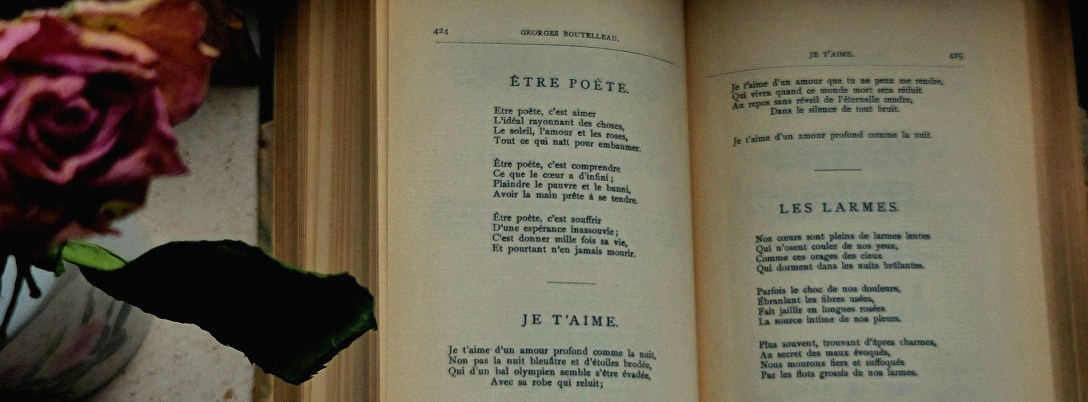
IV. Try Your Hand At Poetry
Even if you don’t officially write poems, it doesn’t matter: now you do 😛 You don’t have to show them to anybody ever, but trying to write at least a few poems of different kinds will help create dazzling twists to use in your prose, whether or not your writing style is particularly flowery. Even if you never produce anything worthy of a Pulitzer-prize, the process will help you approach writing in a fresh way and might be the espresso shot your creative neurons need. Just try not to think about high school poetry class and you’ll be fine.
After writing all that stream-of-consciousness and word lists you should have plenty of raw material for this, anyway!
There’s a lot more out there when it comes to injecting some poetic sparks into your writing, so go ahead and find new ideas if you feel like your writing tastes like moldy bread. Maybe then it will become something more like a fresh, toasty croissant.
X The Foxglove Scribe

 The Foxglove Scribe