
Descriptions are an interesting playground. It seems to be one of those things where it’s hard to get it just right – if you’re trying to please some imaginary average audience, that is. Nevertheless, there are certain conventions and, let’s say ”purpleness ranges”, that do exist in the modern publishing landscape, and you’ll probably ignore them to your peril. I sincerely do not believe Thomas Hardy would be able to convince a modern publisher that his 3 + page description of a night-time scene of English countryside would be a good idea to slap in the second chapter of a book, as well as it works in Far From the Madding Crowd. Gorgeous description, mind you, but few modern readers, unfortunately, would have the patience to read about trees wailing and thin grasses being touched by breezes of differing powers for paragraphs. The requirements of description simply stand different in 2026.
Common problems with description include the ones you might guess: too much, too little, or too confusing. These are, naturally, subjective to a high degree, but for most things in life and writing there’s an invisible bell curve with a common center of gravity where the average settles. That isn’t to say you should strive for that average, but it’s a good idea to know what it is.
Most modern audiences are not going to sit through you describing a room for two full pages, but they will also be confused and irritated if everything happens in barely sketched, loosely hanging abstract blurs of surroundings. At the very least, the audience needs to feel grounded in your scenes and have the chance to see it in their mind’s eye. (I have heard that some people don’t see visual images when they read, and I don’t know how you do it.) Even sparse and straightforward narration can create a wonderful sense of the space and scene, and more doesn’t always equal better. I do have a penchant for lush descriptions, but I would also get bored if we paused the plot to intricately detail every curve on the mansion’s 18th century tapestries for several paragraphs. Whichever end you tend towards, you first need to have something on the page in order to worry about the quantity later.
Ever feel like you simply can’t summon the right words, or even the right image, for a given location? We’ve all been there. Even after writing 5+ manuscripts worth of scene descriptions, I sometimes get this empty beat where I start defaulting to things like ”the golden glow” and ”star-strewn sky” and other phrases I’ve seen too many times in others’ books. Things that aren’t bad in themselves, but feel a bit…worn. Like coming across the same outfit trend everywhere. It might look great, but you’ve seen it so much it loses any spark of novelty or uniqueness it once may have had.
Whilst one could write whole essays on the craft of descriptions, in this post I want to focus on a simple, practical exercise you can use to instantly glow up your wordcraft. I wouldn’t think I’m the first one to ever have this idea, but it did bloom in my mind one fine day when I was browsing my story inspirations board on Pinterest.
Le Description Exercise
This one is simple, and pretty fun.
I. Go on Pinterest/Google/image source of choice and find a picture that inspires you. I highly recommend maintaining specific moodboards and story image repositories on Pinterest – it’s one of the best ways to get out of a creative slump with your story.
II. Write down all the words that it makes you think of. They can be abstract, too. Definitely use a Thesaurus or equivalent here! This opens up a wealth of words you might not have thought of.
III. Pick 1-4 at a time and string them into a descriptive sentence or fragment. Write as many sentences/fragments as you can think of, and don’t worry about going overboard with the language or being grammatically accurate – this is for your brain to rev up the creative engine.
IV. Look at the sentences you have with a more critical eye and think of how they could be improved. Swap something out? Cut excess adjectives, or rearrange things into a punchier metaphor? Play with sentence structure and cadence, listen to the melody of the words.
V. Incorporate as many of the sentences as you want into a short paragraph. It could be a part of a story or something completely random, but it needs to sound coherent and pleasing to you.
You can write long paragraphs or several shorter ones, it doesn’t really matter. The point is that you get a hang of describing in richer detail and depth, picking out details you might usually gloss over, and really looking at the inspiration images to see what your imagination comes up with.
TIP: Don’t limit yourself to what a scene looks like, but imagine what the smells and sounds would be, what materials would feel like to the touch, and even taste if food is involved. Think of adding items or details unique to your characters and the world, especially if you want to use the exercise to develop a work in progress.
Here’s a couple of my example practises so you can see exactly what I mean.
The Terrazza
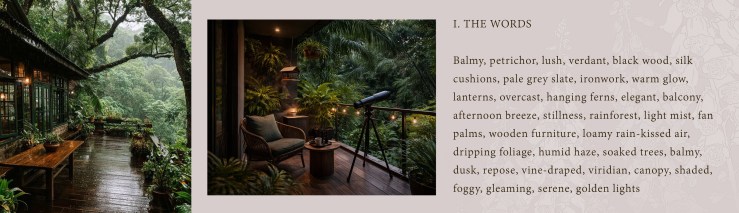
*NOTE: As you can see, I included words that aren’t strictly based on the image, but rather conjured up by my imagination as things that could fit in with this view and expand it. For example, the pale grey slate for statues and path stones I’d imagine to be in the gardens below, and the silk cushions would go perfectly with the aesthetic. I also imagined the railing as beautiful wrought iron rather than the basic design in the images.
II. Stringing Sentences
– Rattan, coarse silk, the balmy elegance of a rain-kissed evening
– The dusky afterglow of a rainstorm
– The lilt of stone fountains in the nooks of a misty tropical garden
– Foliage wet and bright through the humid haze
– Scent of petrichor and the feel of a damp iron railing after the rains
– Light mist wrapping the fan palms
– The wet gleam of wood
III. The Paragraph
”Emory leaned on the blackwood balcony railing and drew in the rain-kissed air. These moments were his favorite, when the downpour has passed and left a cool serenity in their wake, framed by hanging ferns and calls of wildlife echoing deep in the canopies surrounding the estate. He sat on the woven wood couch with pillows of coarse silk procured from Callisto, and flipped open the Astronomer’s Daily lying on the lounge table.
Someone had left a nearly finished bowl of spica nuts and a dark blue fan next to it.
Lavinia. His mother loved these tranquil corners of the Saviere estate even more than he did; Emory could almost smell the lingering trace of her magnolia perfume mingling with the humid scent of the forest.”
= Longer section including story narrative and deeper characterisation. You get a better sense of the characters, the world, and their relationship to it, with added little details like the Astronomer’s Daily and ”spica nuts” that show we’re in some imaginary world. (Space fantasy, to be exact). It’s these little touches that ground the scene and make it feel realistic, in a way no amount of describing the palm tree’s exact shape ever will.
The Oriental Bedroom
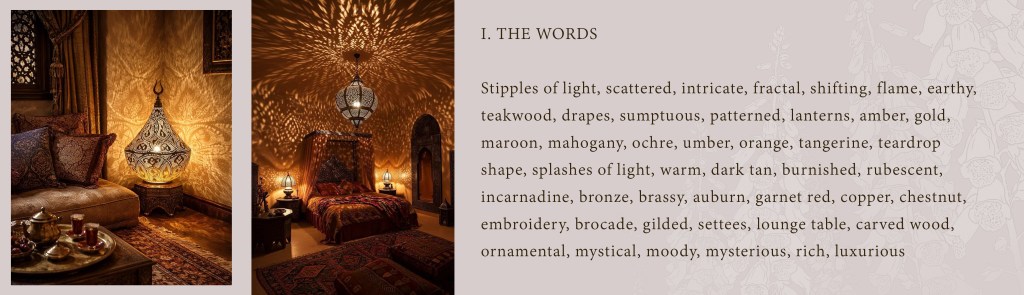
II. Stringing Sentences
– Shifting fractals of light
– The burnished glow of brass lanterns
– Rich mahogany and umber, splashes of tangerine
– Teardrops of gold hanging from hexagonal lanterns
– Drapes of sumptuous, ornamental velvet thrown on teakwood settees
– A carafe of rose wine on a bedside, petals scattered by sticky date rolls on ivory plates
– Intricately carved wooden furniture, the oval arch of the door frame
– Haze of incense, creating an atmosphere of myth and luxury
III. The Paragraph
”The fractals of light thrown by the brass lantern enclosed the room in a cage of shifting shadows. Valera swept aside the strings of topaz by the door and stepped in. The sandstone floor felt cool beneath her bare feet, and the heady scent of sandalwood and frankincense filled her lungs and mind with hazy dreams of some faraway place she’d never seen; one where desert winds sang and the sky was painted with diamonds. Robust mats and throws of deepest garnet, patterned with threads of amber and symbols of bygone kingdoms, covered every available surface.”
= An introduction to a specific space, throwing in some more abstract thought from the character’s perspective to round out the feeling of the world. I’ve included things that weren’t even in the original images, and that’s also fine: if the image in your head/in front of you really vibes with the story, you’ll quickly find yourself coming up with more and more details to round out the scene. It doesn’t matter if the sentences aren’t Nobel prize level; this is for your own practise.
Conclusion
My two examples center on describing places and spaces, because that’s what I was practising at the time, but you can use these techniques on anything your heart desires: plants, animals, people, events, moods, food…
The point is that you feed your mind on X in order to produce Y. The creative mind needs input and stimulation to perform at its best, and if you forge on through manuscript after manuscript without ever taking time to consciously develop your craft, you’re overlooking a major step in growing as a writer. Naturally, we strengthen our writing chops by the simple act of writing new material, but it’s easy to fall into comfortable ruts if you never challenge yourself.
In the current publishing climate, this is more important than ever. With literature being increasingly pushed into safe, easy-to-read and simplistic moulds, it’s up to us artists to keep alive the tradition of literature that actually makes the reader feel something and takes them some place they’ve never been. If the acceptable standard is a slew of recycled expressions and worn-out descriptions, it’s no wonder we keep coming across the same bare-bones scene building and get used to lower quality in descriptions, dulling down our tolerance for depth and complexity.
Hopefully these exercises help you to refine in your own wordcraft in a way that develops your unique voice and allows you to deliver what good descriptions should: a deep, wonderful immersion that sweeps one up into the world of the story.
Descriptive writing,
x The Foxglove Scribe

 The Foxglove Scribe